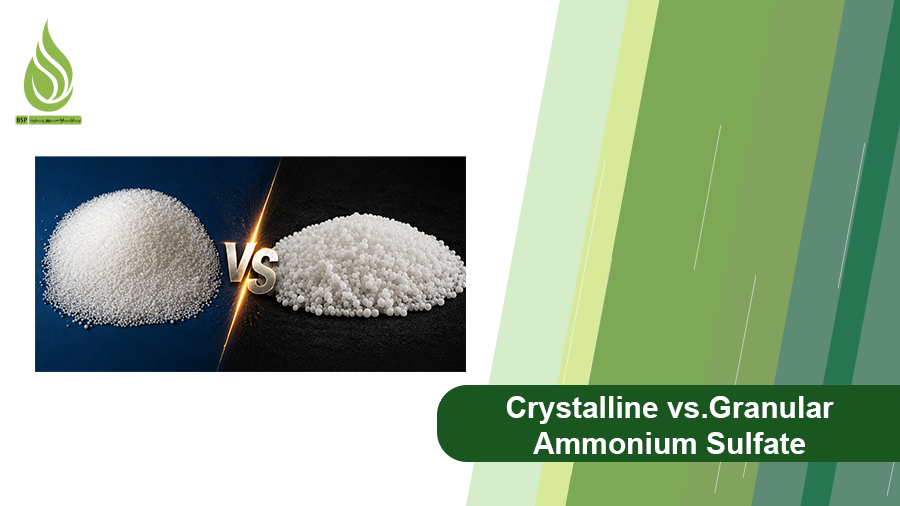
Crystalline vs Granular Ammonium Sulfate: Which One Should You Import?
If you need maximum nitrogen-sulfur concentration for direct application or industrial use, choose crystalline ammonium sulfate. If you’re blending fertilizer or spreading with mechanical equipment, granular ammonium sulfate is the better fit. Everything else below explains why and how to make the right call for your operation.
Crystalline vs Granular Ammonium Sulfate
Before you place an order, it helps to see both grades side by side. This table covers the specifications that actually matter for import decisions: nutrient content, handling, and how each grade behaves once it reaches your warehouse or blending line.
| Specification | Crystalline Ammonium Sulfate | Granular Ammonium Sulfate |
|---|---|---|
| N% / S% content | ~21% N / ~24% S (higher concentration per unit weight) | ~21% N / ~24% S, but slightly lower effective density per bag due to granule structure |
| Particle size | Fine crystals, typically 0.5–2 mm | Uniform granules, typically 2–4 mm |
| Bulk density | Higher | Slightly lower, more consistent granule-to-granule |
| Dust level | Higher dust generation during handling | Low-dust, easier to handle without respiratory concerns |
| Blending compatibility | Poor; tends to segregate when mixed with other granular fertilizers | Excellent; matches particle size of NPK and other blend components |
| Typical use case | Direct soil application, industrial and food-grade use, textile and chemical manufacturing | Fertilizer blending, bulk blending plants, mechanical broadcast spreading |
| Typical packaging | 25 kg / 50 kg bags, jumbo bags, bulk vessel | 25 kg / 50 kg bags, jumbo bags, bulk vessel |
| Price positioning | Generally lower cost per ton (simpler production process) | Slight premium reflecting the granulation step |
Both grades carry essentially the same nutrient profile on paper. The real differences show up in how the product moves through your supply chain; during shipping, storage, blending, and application. That’s the part most buyers underestimate until it’s too late.
What Is Crystalline Ammonium Sulfate?
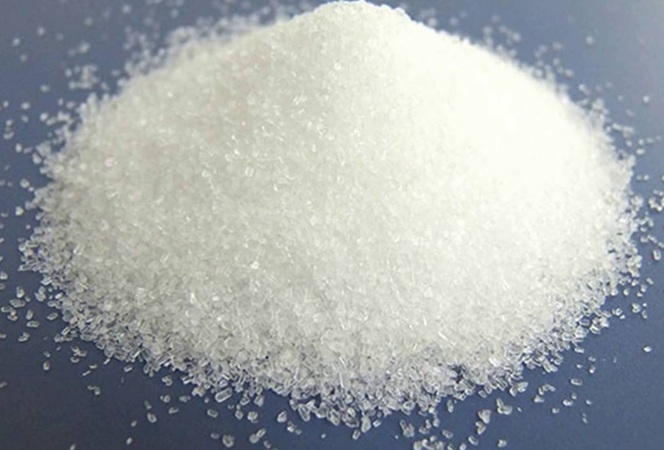
Crystalline ammonium sulfate is the raw, unprocessed form of the fertilizer: fine, sugar-like crystals produced directly as a byproduct of caprolactam manufacturing or through synthetic production. It’s the form most closely associated with the original chemistry: no additional binding, rounding, or coating steps are applied. This is the grade BARNO produces at scale, and it’s a meaningful point of differentiation; BARNO is positioned as the sole crystalline ammonium sulfate producer in the Middle East, with an annual output of 90,000 metric tons.
Because there’s no granulation step, crystalline ammonium sulfate delivers nutrients in their most concentrated, immediately available form. When it dissolves, whether in soil moisture or industrial process water, it does so quickly and completely, releasing nitrogen and sulfur without any delay caused by a granule shell breaking down first.
What Is Granular Ammonium Sulfate?
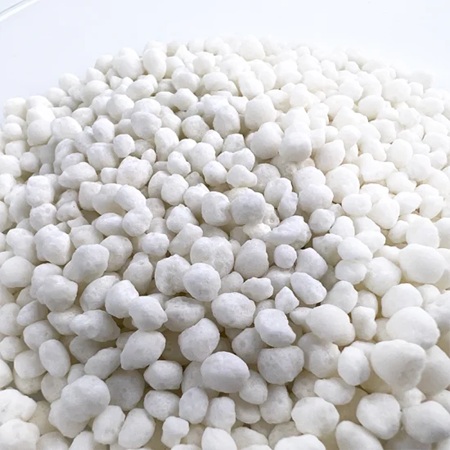
Granular ammonium sulfate starts as the same crystalline base material, then goes through an additional compaction or agglomeration process that binds the fine crystals into larger, more uniform particles. The goal of granulation isn’t to change the chemistry; it’s to change the physical behavior of the product.
Granulation solves three practical problems that come up constantly in commercial agriculture: dust during handling, poor flow through mechanical spreaders, and incompatibility with other granular fertilizers during blending. The result is a product that looks and behaves much more like the urea, MAP, DAP, or potash it’s commonly mixed with.
When to Choose Crystalline
Crystalline is the right call in a few clear situations:
- Direct-application farms. If your buyers are applying ammonium sulfate straight to the field, dissolved in irrigation water, broadcast on its own, or used in fertigation systems, the fine particle size actually works in your favor. Faster dissolution means faster nutrient uptake.
- Industrial, textile, and food-grade use. Ammonium sulfate isn’t only an agricultural input. It’s used in food processing (as a flavor enhancer and dough conditioner), in the leather and textile industries, and as a coagulant and precipitant in various industrial chemical processes. In nearly all of these cases, the crystalline form is what’s specified, since granulation adds no value outside of agricultural spreading.
- Buyers prioritizing maximum N-S concentration per shipment. Because there’s no binding agent and no granulation loss, crystalline ammonium sulfate offers a very direct cost-per-nutrient-unit calculation; you’re paying for nitrogen and sulfur, not for processing.
This is also the grade to specify if you’re sourcing from a supplier with deep production expertise in the crystalline form specifically. Barno Ammonium Sulfate is built around this exact strength, with consistent N-S content and quality control tuned to crystalline output rather than treating it as a byproduct of a granulation-first operation.
When to Choose Granular
Granular is the stronger choice when your business model depends on consistency and mechanical efficiency:
- Fertilizer blenders. If you’re running a bulk blending operation, combining ammonium sulfate with urea, MOP, DAP, or micronutrient package, particle size match is critical. Mismatched particle sizes cause segregation during transport and storage, meaning the bag or bulk load your farmer-customer opens may not have the nutrient ratio you promised on the label. Granular Ammonium Sulfate solves this by matching the granule size of standard NPK components.
- Mechanical spreader compatibility. Broadcast application via mechanical spreaders depends on uniform particle size and bulk density to achieve even field coverage. Crystalline material, with its finer and less uniform particle structure, doesn’t flow consistently through spreader mechanisms designed for granular products, leading to uneven application and wasted input.
- Co-granulation with NPK blends. Some buyers go a step further and co-granulate ammonium sulfate directly into an NPK formulation, creating a single homogenous granule with multiple nutrients. This is only possible starting from granular or near-granular feedstock, making granulation a prerequisite step rather than an optional upgrade.
There’s also a practical handling argument for granular: lower dust means fewer product losses during transfer, less respiratory irritation for warehouse and application crews, and generally easier compliance with workplace safety standards; all of which matter more at scale.
Storage, Handling, and Application: The Practical Differences
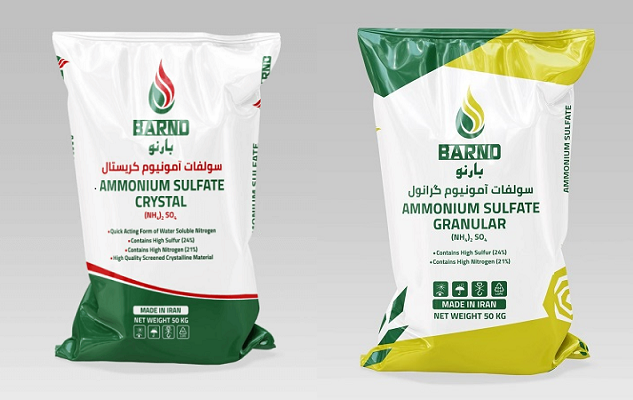
Beyond the spec sheet, three real-world factors tend to decide which grade a buyer actually prefers once they’ve imported a few shipments:
Moisture absorption and caking resistance. Both grades are hygroscopic to some degree, but crystalline ammonium sulfate’s finer particle structure and larger surface area make it somewhat more prone to caking under humid storage conditions if bags aren’t sealed and stacked properly. Granular product, with its lower surface-area-to-volume ratio, generally shows better caking resistance and storage stability over longer holding periods; a meaningful consideration if you’re importing by vessel and holding inventory for a full season.
Dust-free handling. This is one of the most cited reasons blenders switch to granular. Dust isn’t just a nuisance; it represents actual product loss during unloading, conveying, and bagging, and it creates airborne particulate that most modern warehouse operations are trying to eliminate.
Application method. Broadcast application by hand or via basic spreading equipment tolerates crystalline material reasonably well. Precision broadcast via calibrated mechanical spreaders, or any blend-and-spread operation, performs meaningfully better with granular material because bulk density and particle size are more predictable and consistent from batch to batch.
None of this means one grade is objectively “better”; it means the right grade depends entirely on what happens to the product after it leaves the port.
Does the Grade Affect Price or Shipping?
Yes, modestly. Granulation is an added production step, so granular ammonium sulfate typically carries a small premium over crystalline on a per-ton basis, even though the underlying N-S content is comparable. Shipping costs (freight, packaging, container loading) are largely the same for both grades, since bulk density differences are not large enough to meaningfully change container utilization. For current FOB figures and how pricing has moved this year, see our dedicated Ammonium Sulfate Price Per Ton breakdown rather than relying on general estimates; pricing for a commodity like this shifts with global sulfur and nitrogen input costs and is worth checking before you finalize an order.
Making the Final Call
If you’re still weighing the decision, ask yourself one question: is this product going into a blend, or is it going straight into the ground (or into an industrial process)? Blending and mechanical spreading favor granular. Direct application, industrial use, and maximum concentration favor crystalline. Many experienced importers actually stock both, using crystalline for direct-sale agricultural customers and industrial buyers, and granular for their blending partners, which is why having a supplier capable of Bulk supply Ammonium Sulfate in both grades, rather than just one, simplifies sourcing considerably.
It’s also worth thinking a step ahead to your end customers. If you’re selling into a market where farmers apply fertilizer by hand or through simple irrigation-based systems, common across parts of Central Asia, the Middle East, and South Asia, crystalline’s fast dissolution and lower per-ton cost can be the more attractive offer. If your customer base leans on commercial-scale mechanical spreading or runs its own blending line, as is more typical in parts of Europe, granular removes a layer of operational friction they’d otherwise have to solve on their end. Matching the grade to how your buyer’s customers actually use the product, not just to what’s cheaper on paper, tends to produce fewer complaints and better repeat orders.
One more factor worth factoring into your decision: consistency between shipments. Whichever grade you choose, ask your supplier for a certificate of analysis on every batch, confirming N%, S%, moisture content, and particle-size distribution. Ammonium sulfate is a relatively simple compound, but variability between production runs, especially in granulation uniformity, can quietly affect blending accuracy or spreader performance even when the headline nutrient numbers look identical on paper.

FAQ
Both grades typically carry the same underlying N-S content (around 21% nitrogen and 24% sulfur), since granulation doesn’t add or remove nutrients; it only changes particle structure. In practice, though, crystalline material’s simpler production process means buyers are paying purely for nutrient content with no added processing cost, which is why it’s often viewed as the more “concentrated” value option on a cost-per-nutrient-unit basis.
It’s not recommended. Mixing the two in the same blend or bag creates a particle-size mismatch that leads to segregation during transport and storage; the finer crystalline material settles differently than the coarser granules, so the blend you load isn’t the blend that arrives. If you need both forms, it’s better to keep them in separate SKUs and apply or blend them separately.
BARNO is the sole producer of crystalline ammonium sulfate in the Middle East, running at an annual capacity of 90,000 metric tons. This makes crystalline ammonium sulfate for fertilizer blending feedstock, direct application, and industrial use the core product line, with quality control and consistency built specifically around the crystalline production process rather than treated as a secondary output.
Somewhat. Granular ammonium sulfate generally shows better storage stability and caking resistance over extended holding periods because of its lower surface-area-to-volume ratio. Crystalline material stores well too, but benefits more from proper bag sealing, dry warehousing, and stacking practices to minimize moisture absorption, especially in humid ports or long transit times.