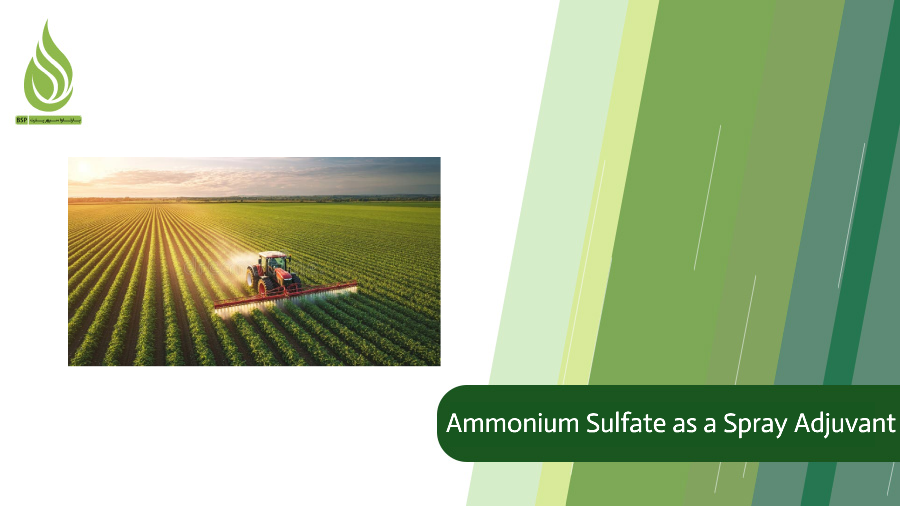
Ammonium Sulfate as a Spray Adjuvant: When Is It Used?
Ammonium sulfate is best known as a fertilizer, but many applicators also keep a bag of it near the sprayer. The reason is simple. When it is added to the spray tank, it can work as a water conditioner and help certain herbicides perform the way they should. This guide explains how an ammonium sulfate spray adjuvant works, when it helps, how it is added, and, just as important, when it should stay out of the tank. If you are looking for fertilizer rates per acre, that is a different topic. Here, the focus is spray water quality and herbicide efficacy.
What Is Ammonium Sulfate Doing in a Spray Tank?
In a spray tank, ammonium sulfate (often shortened to AMS) is not acting mainly as a fertilizer. It acts as a water-conditioning spray adjuvant. Here is the problem it addresses. Water used for spraying is rarely pure. It often carries dissolved minerals, especially calcium and magnesium. These hard-water ions can interact with certain pesticide active ingredients and reduce how well they work. This is called antagonism. Ammonium sulfate as an adjuvant can help reduce that effect. So when someone asks why anyone would put ammonium sulfate in a pesticide spray tank, the short answer is this: to offset the effect of hard water on certain products. The fertilizer value of the nitrogen and sulfur is a side effect, not the goal.
How Does Ammonium Sulfate Improve Spray Water?
The chemistry sounds complicated, but the idea is easy to follow.
Without conditioning:
- Hard water carries positively charged ions (cations) such as calcium and magnesium.
- These cations interact with susceptible pesticide molecules in the tank.
- The pesticide becomes less available to the plant, and performance drops.
With ammonium sulfate added:
- Sulfate ions in the water interact with the hard-water cations.
- This reduces how much those cations can bind to the pesticide.
- More of the active ingredient stays available to do its job.
The ammonium cation also appears to help. Some extension guidance suggests it can improve how certain herbicides move into the plant. Purdue and UF/IFAS both describe this water-conditioning role in practical terms. Think of it as giving the minerals something else to bind with, so they leave your herbicide alone.
When Is Ammonium Sulfate Most Useful as an Adjuvant?
An AMS spray adjuvant tends to be most useful when two things are true: the water is hard, and the herbicide is sensitive to hard-water cations. The best-known examples are weak-acid herbicides. These products can bind to calcium and magnesium and lose activity. Common examples include:
- Glyphosate. Ammonium sulfate with glyphosate is one of the most widely discussed pairings, because glyphosate is a weak acid that can be tied up by hard-water cations.
- Glufosinate. Many labels for glufosinate recommend or require AMS to improve performance.
- Some other herbicides where the label specifically calls for ammonium sulfate.
One sentence matters more than all the others in this article: the pesticide label always takes priority. Do not assume ammonium sulfate belongs in every herbicide spray. It does not. Some labels require it, some allow it, and some prohibit it. If the label does not mention AMS, you should not add it based on habit or a neighbor’s advice.
Ammonium Sulfate and Hard Water
Hard water is the main reason AMS earns a place in the spray tank, so it is worth understanding.
- What makes water “hard.” Water hardness comes from dissolved minerals, mostly calcium and magnesium. Iron can also be a concern. Virginia Tech identifies calcium, magnesium, and iron as important hard-water cations that can interfere with certain pesticides.
- Where hard water comes from. Well water and some surface water pick up minerals as they move through rock and soil. If you also deal with hard irrigation water, it is likely your spray water has similar characteristics, though you should test each source separately.
- Why testing matters. You cannot judge hardness by looking at water. A water test tells you the hardness level, and often the alkalinity and water pH too. These numbers help you decide whether conditioning is worth considering at all. Soft water from a clean source may need no conditioning, and adding AMS there accomplishes little.
A few practical points:
- Test the exact water source you fill the sprayer from.
- Retest if you switch sources, since hardness can vary between wells, ponds, and municipal supplies.
- Keep records so you know what water you used with which product.
Good agricultural water management starts with knowing what is in the water before it ever reaches the tank.
How Much Ammonium Sulfate Should Be Added to Spray Water?
This is the question people ask first, and the honest answer is: check the pesticide label first. Extension publications mention rates of roughly 8.5 to 17 pounds of ammonium sulfate per 100 gallons of spray solution in certain hard-water situations. That is about 1 to 2 percent weight per volume. These figures are useful for context, but they are not a universal recommendation. The right amount depends on several things:
- The pesticide label and its stated AMS rate
- The herbicide formulation
- The hardness and quality of your spray water
- Local extension recommendations
The safe approach is straightforward. Read the label. If it permits or recommends AMS, follow the labeled concentration or the applicable extension guidance for your area. If the label is silent or says not to use it, do not add it. Also, remember that this is a spray-tank rate, not a fertilizer application rate. The two are measured differently and serve different purposes.
How to Add Ammonium Sulfate to the Spray Tank
For products where the label recommends AMS, extension guidance commonly suggests adding the ammonium sulfate to the water first and letting it dissolve completely before adding the herbicide. Virginia Tech Publications describes this approach. A general sequence looks like this:
- Fill the tank partway with clean water.
- Start the agitation. Keep it running throughout mixing.
- Add the ammonium sulfate and let it dissolve fully. Check that no solids remain at the bottom.
- Add the herbicide and any other approved products, following the label.
- Finish filling the tank with water.
Dissolving matters. Undissolved granules can clog screens and nozzles, and the product will not condition the water until it is in solution. Spray-grade or fully soluble material dissolves more readily, and you can learn more about this in our guide to ammonium sulfate solubility in water.
Keep one caution in mind: this sequence is a general outline, not a rule. The product label controls the final tank mix order. Different products can call for different sequences, and compatibility problems can cause clumping or separation. Our guide to fertilizer compatibility and mixing explains how to think about these risks, and a small jar test before filling the tank is a smart habit.
When Should You Not Use Ammonium Sulfate as a Spray Adjuvant?
Knowing when to skip AMS is just as important as knowing when to use it. Avoid the ammonium sulfate spray adjuvant in these cases:
- The pesticide label does not allow it. If the label prohibits AMS or does not mention it, leave it out.
- Another adjuvant is specifically required. Some labels call for a particular surfactant, oil, or other additive instead.
- Water hardness is not the problem. If your water is soft, AMS offers little benefit. Adding it anyway just adds cost and mixing steps.
- Water pH is the real issue. If the trouble is high or low water pH, a buffer or acidifier is the right tool, not a water conditioner.
- AMS can create unwanted effects. Some products react poorly with it.
A particularly important example comes from NC State. AMS should not be added to volatile products such as certain 2,4-D or dicamba formulations, because it can increase volatilization and off-target movement. That could mean drift onto neighboring crops and serious damage. This is why “add AMS to everything” is bad advice. The label, the water, and the product all have to point in the same direction.
Ammonium Sulfate vs Other Spray Adjuvants
Spray adjuvants are not interchangeable. Each one does a different job, and Penn State’s spray adjuvant guidance offers a helpful way to sort them:
| Adjuvant type | Main function |
|---|---|
| Ammonium sulfate (AMS) | Water conditioning, reduces hard-water antagonism |
| Surfactants | Improve wetting and spreading on the leaf |
| Buffers | Stabilize spray solution pH |
| Acidifiers | Lower spray water pH |
| Deposition agents | Improve retention and deposition on the target |
The key point is that ammonium sulfate solves a hard-water problem. It does not replace a surfactant, and it does not fix pH. If a label calls for more than one adjuvant, each is there for a reason, and each should be used as directed.
Final Thoughts
An ammonium sulfate spray adjuvant can make a real difference when hard water is limiting herbicide performance, especially with weak-acid herbicides like glyphosate and glufosinate. It works by letting sulfate ions tie up calcium, magnesium, and other cations before they tie up the pesticide. But it is not a universal additive. Test your water, read the pesticide label, follow the recommended rate and mixing order, and skip AMS wherever the label or the product says no.