Coffee Plant Fertilization: How Nitrogen and Sulfur Support Growth and Yield
Coffee plant fertilization is one of the few yield factors a grower controls directly. A coffee tree grows leaves, wood, flowers, and a heavy crop of fruit at the same time, and each one draws on the soil. When coffee plant nutrition falls short, yield falls with it. This guide explains how coffee plant fertilization works across the crop cycle, where nitrogen and sulfur fit in, and how to build a plan for your own farm.
Coffee Fertilizer Requirements: Arabica vs. Robusta

Two species dominate production. Coffea arabica, or Arabica coffee, usually grows at higher elevations and yields less per hectare. Coffea canephora, or Robusta coffee, thrives in warmer, lower areas and carries heavier crops. Because Robusta removes more nutrients at each harvest, its coffee fertilizer requirements are often higher, especially for nitrogen and potassium.
Species is only one factor. Shade, altitude, planting density, and yield goals all change coffee plant nutrient requirements, so treat any published rate as a starting point, not a prescription. The best fertilizer for coffee plants is the one matched to your own soil and crop load.
Why Nitrogen Drives Leaf and Plant Growth
Nitrogen fertilizer for coffee supports the vegetative side of the tree. Through nitrogen uptake, the plant carries out amino acid synthesis, and those amino acids then become proteins and enzymes. Nitrogen also supports chlorophyll production, the engine of photosynthesis. More healthy leaf area means more energy for new branches, and that matters because coffee fruits mainly on new wood. Growth this season sets up next season’s crop.
Early shortage shows as pale older leaves, short branches, and a thin canopy. More is not always better, though. Excess nitrogen pushes leafy growth at the expense of fruit set and is easily lost from the soil.
How Sulfur Supports Protein Formation
Sulfur for coffee plants is easy to overlook. Through sulfur assimilation, the plant makes cysteine and methionine, two amino acids essential for protein formation and enzyme activity. Without enough sulfur, proteins cannot be built efficiently, even when nitrogen is plentiful.
Deficiency resembles nitrogen shortage but appears first on young leaves, because sulfur moves poorly inside the plant. Risk is highest on weathered soils with low soil organic matter, where sulfate washes out easily.
How Nitrogen and Sulfur Work Together
Nitrogen supplies the building blocks, and sulfur helps assemble them into protein. When one is short, the other is used poorly, which lowers nutrient uptake efficiency. A tissue ratio of roughly 15 parts nitrogen to 1 part sulfur is often cited as a balanced target. For the wider picture, see our guide to nitrogen and sulfur requirements in corn.
Nitrogen and Sulfur Are Not the Whole Story
Good coffee plant fertilization covers more than two nutrients. Potassium leaves the farm in large amounts with the cherries and is critical for fruit filling. Phosphorus supports roots and establishment. Magnesium is central to chlorophyll, and shortages are common on acid soils high in potassium. Calcium, managed mainly through liming, supports cell walls. Boron and zinc influence flowering, fruit set, and shoot growth. A missing nutrient limits the response to everything else, so review plant nutrient deficiencies before raising nitrogen rates.
Coffee Plant Fertilization by Growth Stage
- Vegetative growth. Post-harvest pruning triggers a flush of regrowth. Apply nitrogen with sulfur and phosphorus at the start of the rains, when roots are active and soil is moist.
- Before flowering. Coffee flowering follows rain after a dry spell. Avoid heavy nitrogen now, since it favors leaves over blossoms. Focus on balanced potassium, boron, and zinc so flowering is uniform.
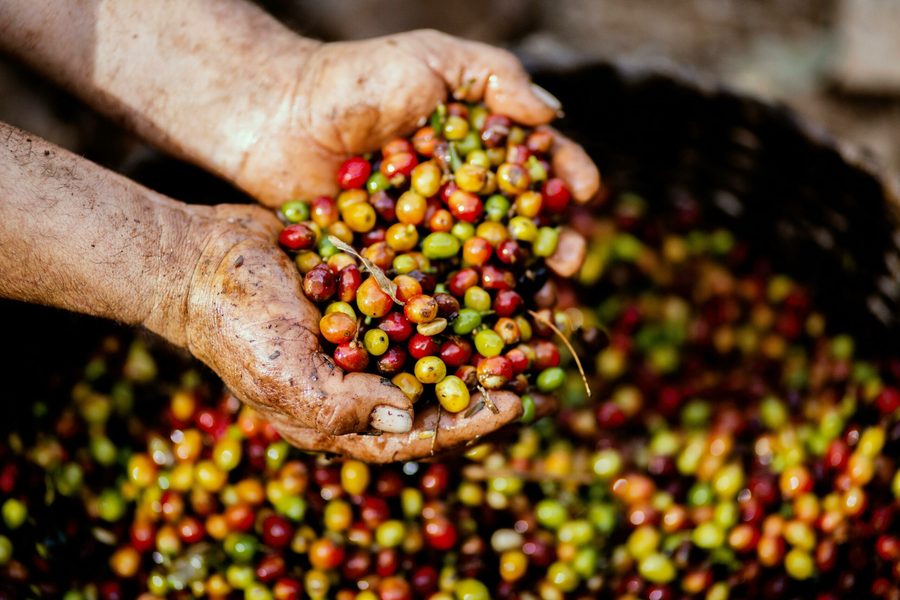
- Fruit development. From fruit set through cherry formation, demand for potassium and nitrogen peaks. Plants that run short abort fruit or produce light beans, so use split fertilizer application to keep nutrients available as cherries fill.
Young Plants vs. Mature Trees
Coffee plant fertilization changes as the tree ages. Young plants are building roots and a frame, while mature trees are carrying a crop and renewing bearing wood.
| Factors | Young plants (years 1–3) | Mature, productive trees |
|---|---|---|
| Goal | Roots, frame, canopy | Sustain yield, renew bearing wood |
| Nitrogen | Small, frequent doses | Higher total, tied to yield target |
| Potassium | Modest | High, replaces crop removal |
| Placement | Small ring near the stem | Band at canopy edge |
| Main risk | Root burn from concentrated granules | Imbalance and leaching losses |
Fertilizer Application Methods and Timing
Coffee fertilizer application works best when granules go in a band or ring under the canopy edge, where feeder roots are most active, and stay clear of the stem. Apply to moist soil, never in dry spells or on saturated ground.
Rainfall and nutrient leaching are the main enemies of efficiency. Nitrogen and sulfate both move with water, so one large dose before heavy rain can be largely wasted. A typical coffee fertilization schedule uses three to four splits: one at the start of the rains, one or two during fruit development, and a light one after the main harvest. Follow local rainfall rather than the calendar. A nitrogen and sulfur fertilizer for coffee production can supply both nutrients in a single pass.
Common Nutritional Problems
- Pale older leaves: nitrogen shortage.
- Pale young leaves: sulfur shortage.
- Yellowing between veins on older leaves: magnesium.
- Scorched leaf edges, early leaf drop: potassium.
- Poor fruit set, distorted young leaves: boron.
Always confirm with testing, since several problems look alike and coffee tree fertilization decisions should rest on data.
Building a Site-Specific Fertilization Plan

A site-specific approach keeps coffee plant fertilization efficient and affordable.
- Test the soil for pH, organic matter, potassium, magnesium, calcium, phosphorus, and sulfur.
- Use coffee leaf analysis each year, sampling the same leaf pair at the same time of season.
- Set a realistic yield target for each block.
- Divide nutrients by growth stage and split them across the rainy season.
- Adjust for conditions such as shade, rainfall, and soil organic matter.
- Keep records and review them every season.
Sound coffee plantation management treats this plan as a living document that improves with each harvest.
Conclusion
Coffee plant fertilization works best when it is balanced, timed to the crop cycle, and based on data from your own soil and leaves. Nitrogen and sulfur drive growth and protein formation, but potassium, magnesium, and micronutrients complete the picture. With a clear program, coffee yield improvement becomes steady and repeatable rather than a matter of luck.