Agriculture in Turkmenistan: Major Crops, Water Resources and Soil Challenges
Agriculture in Turkmenistan is a story of desert and water. Most of the country is arid, yet farming still contributes a meaningful share of the economy and employs a large part of the workforce. Cotton and wheat dominate, irrigation makes nearly everything possible, and the same water that feeds crops also creates salinity problems. This guide explains how agriculture in Turkmenistan works: the climate, the main crops, the water system, the soil challenges, and how fertilizer fits into agricultural productivity.
Overview of Agriculture in Turkmenistan
The Turkmenistan agricultural sector is significant but spatially small. One widely cited estimate from 2019 put agriculture at about 11.7 percent of GDP and about 40 percent of employment, even though only around 4 percent of the land is cultivated. The rest is mostly desert pasture, used for livestock such as sheep, goats, and camels. Agricultural production in Turkmenistan is therefore shaped less by land area than by how well scarce water is used on the small cultivated share.
Farming is concentrated in oases and irrigated belts, especially along the Amu Darya River in the northeast, around the Mary region in the southeast, and in the foothills of the Kopet Dag near Ashgabat. Because most land is state-controlled, key crops such as cotton and wheat are grown under production plans and state orders, with farmers working on leased land or smaller household plots.
Climate, Geography, and Farming Conditions
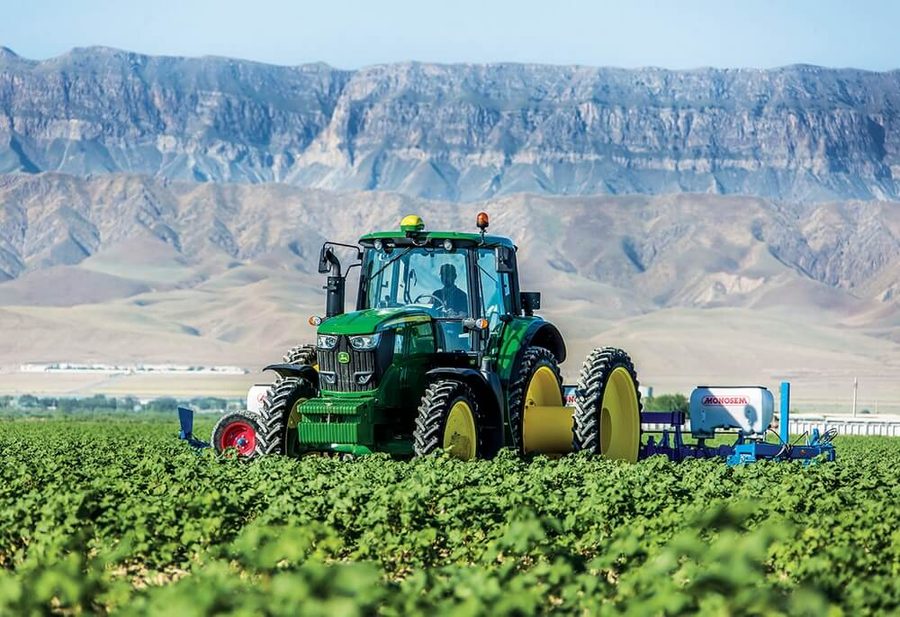
Turkmenistan has a harsh arid climate. The Karakum (Garagum) Desert covers roughly 70 percent of the country. Summers are very hot and dry, winters can be cold, and rainfall is low and uneven. Rain mostly falls in winter and spring, which is the wrong season for cotton.
This is why farming in Turkmenistan is overwhelmingly irrigated agriculture. FAO estimates have put the irrigated area at around 1.3 million hectares, nearly nine-tenths of cultivated land. Rain-fed farming exists only in limited areas, mainly in the foothills, and it carries much higher risk. The practical conclusion is simple: in desert agriculture, water management comes before every other input.
Major Crops Grown in Turkmenistan
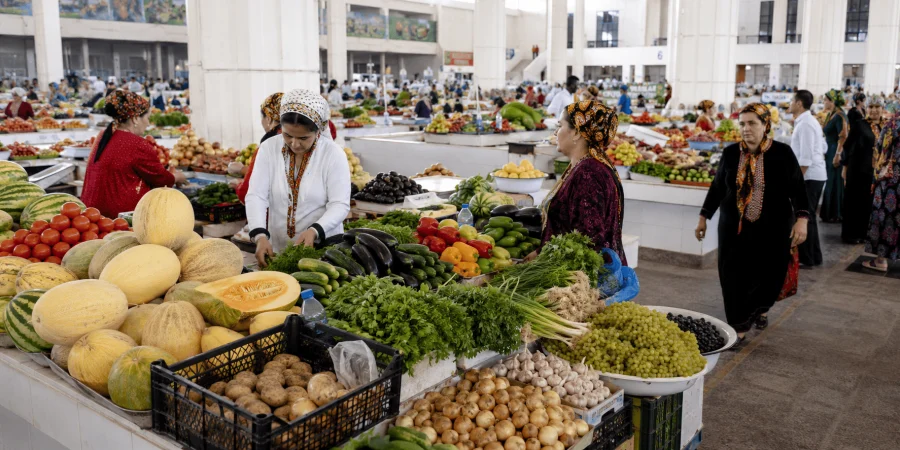
Agriculture in Turkmenistan is organized around a short list of crops, and the crops grown in Turkmenistan reflect both climate and policy. Cotton and wheat are the two main field crops, with wheat grown on the larger area. Other crops include barley, rice, maize, sugar beet, potatoes, vegetables, melons, and fruit. Citrus, grapes, pomegranates, figs, olives, and dates are grown in suitable microclimates, with many fruits and vegetables produced on small household plots.
Policy matters because cotton, wheat, rice, and sugar beet have been treated as strategic crops, with production targets and state procurement. This helps explain why cotton and wheat shape land use, water allocation, and input demand across the country.
Cotton Production
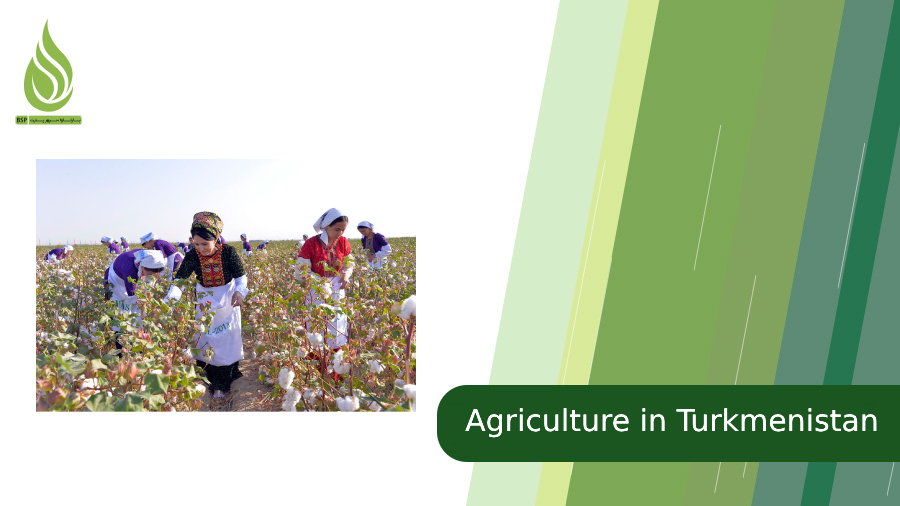
Cotton production has long been the backbone of irrigated farming in Turkmenistan, and the country ranks among the larger cotton producers globally. Official statistics show cotton on roughly half a million hectares, and about half of the irrigated area was historically planted to cotton.
Cotton needs warm temperatures and a long season, which suits Turkmenistan, but it is demanding on water and sensitive to salinity during early growth. Since 2019, policy has emphasized processing cotton domestically into yarn and textiles rather than exporting raw fiber. Independent reports have also questioned some official output figures, so production numbers should be read with caution.
Wheat Cultivation
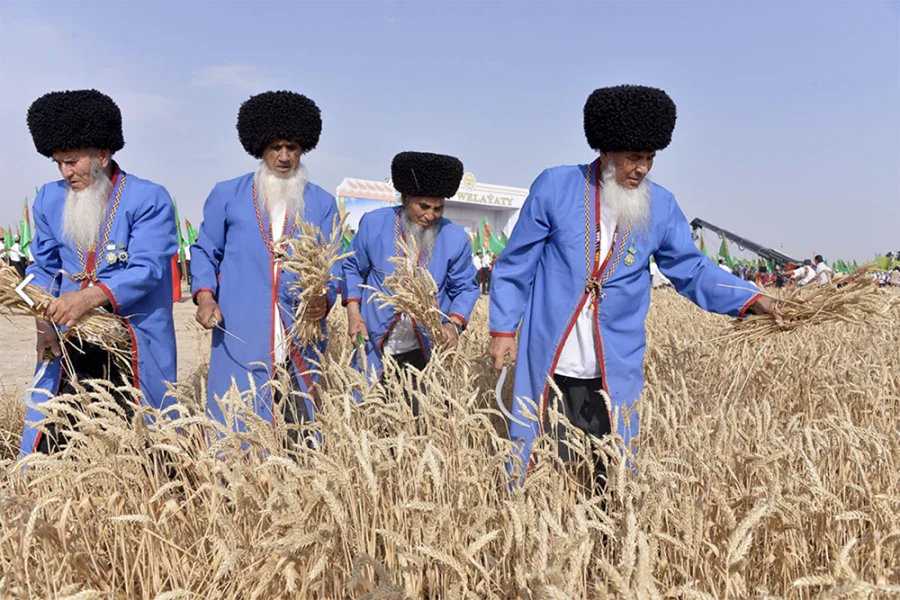
Wheat cultivation expanded sharply as the country prioritized food self-sufficiency. Official statistics show wheat on roughly 760,000 hectares, making it the largest crop by area. Most wheat is winter wheat, sown in autumn and harvested in early summer, which lets it use winter and spring moisture alongside irrigation.
Wheat faces its own pressures: late-spring water shortages, heat during grain filling, and rust and pest outbreaks. Because wheat and cotton compete for the same canal water at different times of the year, irrigation scheduling between them is one of the sector’s central challenges.
Irrigation and Water Resources
Water is the limiting factor for agriculture in Turkmenistan, and irrigation in Turkmenistan depends heavily on a single river system. Agricultural irrigation here means moving water over long distances through canals before it ever reaches a field. The Amu Darya River supplies the bulk of the country’s water, with one UN-based estimate putting it near 90 percent. The Karakum Canal, built between 1954 and 1988, carries roughly 13 cubic kilometers a year from the Amu Darya across the desert, and it is about 1,375 kilometers long. It opened huge areas to cotton and also supplies Ashgabat. Smaller rivers such as the Murghab and Tejen, plus reservoirs and local groundwater resources, support oases in the south.
Several issues limit efficiency. Parts of the canal system lose water through seepage, and much irrigation is still done by surface flooding. Upstream use by other countries and variable river flows also affect supply. Reports of irrigation water shortages during critical growth periods have appeared repeatedly over the years.
Water Scarcity and Drainage
Water scarcity in Turkmenistan agriculture is not only about quantity. Over-irrigation and poor drainage raise groundwater tables, which brings salts toward the surface. Agricultural drainage water, rich in salts, has to go somewhere. Collectors carry it to desert depressions, and the Golden Age (Altyn Asyr) Lake project was designed in part to receive it.
Critics say drainage networks and maintenance have lagged behind new irrigated land, which can reduce yields. The lesson for farmers is that irrigation and drainage must be planned together. Adding water without removing excess salts only postpones the problem.
Soil Conditions in Turkmenistan
Soil conditions in Turkmenistan vary by region, but many irrigated soils in arid zones share common traits. They are often light-textured, low in soil organic matter, alkaline, and calcareous. Gray desert soils and sandy soils are common, and heavier clay-rich soils (known locally as takyr) occur in depressions. Low organic matter limits water holding and soil fertility, and high pH can reduce the availability of some micronutrients such as zinc and iron.
For agriculture in Turkmenistan, the biggest soil challenge is soil salinity. In hot, dry climates, evaporation draws salts upward, and repeated irrigation with water that carries dissolved salts leads to salt accumulation in the root zone. Salinity stunts seedlings, reduces yield, and makes crops more sensitive to nutrient imbalance. Managing it requires good drainage, leaching with sufficient water, level fields, and crop choices that suit the soil.
Fertilizer Use in Turkmenistan
Fertilizer use in Turkmenistan has been high compared with global averages. One World Bank-based dataset reports about 347 kilograms of nutrients per hectare of arable land in 2023, versus a world average near 154. High use does not always mean efficient use, though. On alkaline, calcareous soils in hot weather, nitrogen can be lost as ammonia gas, and leaching can carry nitrate below the root zone after heavy irrigation.
Sound nutrient management starts with soil testing, irrigation water analysis, and realistic yield targets. Rates should depend on crop type, soil, water, and field history, so there is no single national schedule that fits every farm.
Nitrogen, Sulfur, and Balanced Crop Nutrition
Nitrogen fertilizers are the foundation of cotton and wheat nutrition. Nitrogen drives leaf area and yield, but timing matters. For cotton, excess nitrogen can delay maturity and promote vegetative growth at the expense of bolls. For wheat, splitting nitrogen between early growth and stem elongation generally improves efficiency.
Sulfur fertilizers deserve a careful, soil-specific approach. Some arid soils contain gypsum and sulfate in irrigation water, so sulfur may already be plentiful in those fields. In other places, especially light, low-organic-matter soils, sulfur can be limiting. Testing shows which situation you have. Where sulfur is low, a fertilizer such as ammonium sulfate can supply nitrogen and sulfur together, though its salt effect should be weighed on saline soils. For help identifying symptoms, see our guide to nutrient deficiency in crops.
Nitrogen and sulfur are not the only needs. Phosphorus, potassium, zinc, and iron also matter, and cotton in particular responds to balanced nutrition. Crop rotation, including cotton-wheat rotations and forage crops such as alfalfa where suitable, helps soil fertility and breaks pest cycles.
Fertilizer Supply and Imports
Turkmenistan has built a sizable nitrogen fertilizer industry around its natural gas. Urea plants operate at Tejen, Mary, and Garabogaz, and ammonia and ammonium nitrate are produced at Mary. Reports indicate new capacity under construction, including a nitrogen complex in the Dashoguz region.
Phosphate and sulfur-bearing fertilizers have been a smaller part of the picture. Reported plans include a phosphate and ammonium sulfate plant at Turkmenabat. Until such capacity is fully running, some specialty products and nutrients may still depend on fertilizer imports.
Agricultural Challenges in Turkmenistan
The agricultural challenges in Turkmenistan are closely linked. Limited water and rising salinity reduce yields, and aging canal and drainage infrastructure makes both problems harder to fix. Production plans and state orders for cotton and wheat can limit how flexibly farmers respond to local conditions, such as switching crops on saline fields. Hot summers and variable river flows add further stress, and inefficient fertilizer use can raise costs without raising yields. Because these challenges reinforce one another, solutions that address only one of them rarely last.
Opportunities for Agricultural Sustainability
Several practical steps could improve agricultural productivity and sustainability in Turkmenistan. Agriculture in Turkmenistan has room to grow without using more water if these steps are adopted:
- Modernize irrigation with lined canals, laser leveling, and drip or furrow systems where practical.
- Improve drainage and maintain collectors to control salt accumulation.
- Test soil and water regularly so fertilizer matches real needs.
- Split nitrogen applications to cut losses and improve uptake.
- Build soil organic matter with residues, manure, and rotation.
- Diversify crops to spread risk and reduce pressure on water at peak periods.
Conclusion
Agriculture in Turkmenistan depends on water control, and everything else follows from it. Irrigation makes farming possible, drainage protects the soil, and balanced nutrition turns water into yield. For anyone studying the Turkmenistan agricultural sector, the key point is that productivity gains will come from managing water, salinity, and nutrients together, not from any one input alone. Farmers, advisers, and agribusiness partners who understand these links are better placed to plan crops, irrigation, and fertilizer programs that hold up year after year.