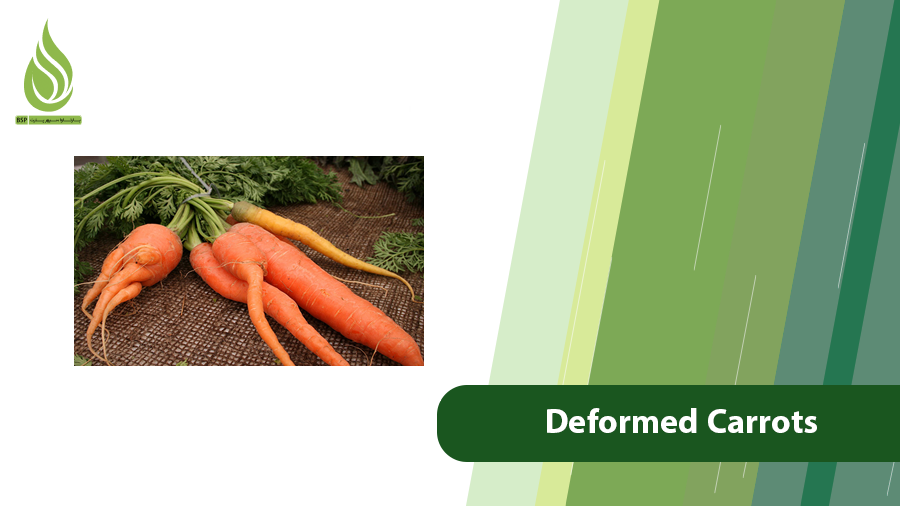
Deformed Carrots: Why They Fork, Twist, and How to Prevent It
Pulling up a crop of deformed carrots, roots that are forked, twisted, stubby, or covered in knobs—is frustrating for any grower. Not only do deformed carrots look unappealing, they also reduce your marketable yield, take extra time to clean and process, and can signal deeper problems in your soil or management. The good news is that deformed carrots are almost always a result of controllable factors. By understanding exactly what pushes a carrot to grow crooked or split, you can prevent the issue and harvest straight, uniform roots every season.
In this guide, we’ll break down every major cause of deformed carrots, from compacted soil and unbalanced fertilizer to improper watering and hidden pests, and give you practical, field-tested solutions.
Why Do Deformed Carrots Matter Beyond Appearance?
Deformed carrots don’t just fail the eye test. Forked, cracked, and twisted roots reduce pack-out rates for fresh markets, increase trimming waste for processors, and generally signal that the crop was under stress. That stress translates into lost yield and lower profits. When you consistently grow straight carrots, you’re showing that your soil structure, water management, and nutrition are all in balance. Recognizing and fixing the causes of deformed carrots is a direct investment in the quality and value of your harvest.
Major Causes of Deformed Carrots and How to Fix Them
1. Poor Soil Structure
Carrots are a root crop that demands a deep, loose, stone-free seedbed. When the developing taproot hits a barrier—a rock, a hard clod, a chunk of wood, or a compacted layer—it cannot grow straight. The tip may die back, forcing lateral roots to expand, or the root may bend around the obstacle. The result is one of the most common types of deformed carrots: forked, twisted, or excessively branched roots.
Additional soil factors that cause deformed carrots include heavy, clay-packed soils that form a crust after irrigation, and the presence of fresh or partially decomposed manure. Fresh manure introduces solid lumps and generates heat as it decomposes, burning the delicate root tip and triggering abnormal branching.

Solutions:
- Deep-plow or fork your carrot beds to at least 12–15 inches before planting. Remove stones, clods, wood fragments, and any other physical debris. The goal is a uniform, soft seedbed. We suggest you take a look at our guide to improve soil structure for more information.
- Avoid planting carrots in fields with standing compaction from heavy machinery. If needed, subsoil to break up hardpan layers.
- Apply only fully decomposed compost or well-rotted manure at least three to four months before seeding. Never incorporate fresh manure into a carrot bed. Well-aged organic matter improves tilth without creating the obstructions that lead to deformed carrots.
2. Unbalanced Plant Nutrition
What you feed your crop—and when—has a direct impact on root shape. Two key nutritional imbalances are behind many cases of deformed carrots:
- Excess nitrogen: Nitrogen fuels leaf and stem growth. When soil nitrogen is too high, especially from quick-release sources like urea, carrots divert energy away from the taproot and produce an oversized top. The root can become stunted, overly fibrous, watery, and prone to fork. Late-season nitrogen pushes also increase cracking and secondary root formation.
- Potassium deficiency: Potassium stiffens cell walls and moves sugars into the root. Without enough potassium, roots lack structural strength, making them more susceptible to soil pressure and physical distortion.
- Boron deficiency: Boron is critical for cell division at the root tip. Even a temporary shortage can kill the growing point, causing the plant to produce multiple lateral roots—a classic deformed carrots symptom. Blackened, hollow crowns are another clue.
Solutions:
- Nitrogen is one of the most common fertilizers and it should be used primarily during the early vegetative stage, when carrots are building their leaf canopy. After the 6- to 8-leaf stage, nitrogen demand drops. Overfeeding nitrogen late in the season is a direct path to deformed carrots.
- Choose a nitrogen source that delivers steady nutrition without harsh salt spikes. Ammonium sulfate (21% nitrogen, 24% sulfur) is an excellent option. It feeds gradually, provides building-block sulfur for protein and oil synthesis, and mildly acidifies the root zone—helping free up phosphorus and micronutrients in alkaline soils. For growers who want a reliable, pure ammonium sulfate, Barno crystalline ammonium sulfate is a trusted choice. It supplies growers with the consistent nutrition that helps crops thrive while reducing the risk of deformed carrots from nitrogen overload.
- Always base your fertilizer program on a soil test. Test for nitrogen, phosphorus, potassium, and micronutrients including boron. Apply potassium and boron according to test results, and split nitrogen applications to match crop uptake. Balanced feeding keeps roots straight and true.

3. Water Stress
Carrots are extremely sensitive to swings in soil moisture. When the soil cycles between dry and saturated, the physical strain on the root can cause it to crack, fork, or develop constrictions.
- Drought followed by heavy irrigation: If the soil dries out and is then flooded, the root swells rapidly and splits its outer skin. This sudden expansion often creates lengthwise cracks and distorted growth.
- Constant overwatering: Waterlogged soil suffocates roots, leading to tip death and the growth of secondary roots that result in forked, deformed carrots.
- Saline water or high-salt fertilizers: High salinity forces the plant to work harder for water. The repeated cellular strain can distort root development and produce short, stubby deformed carrots.
Solutions:
- Maintain even soil moisture throughout the growing season. Drip irrigation is the gold standard for carrots, delivering consistent water to the root zone without wet-dry swings.
- Monitor soil moisture actively and irrigate before the soil becomes bone dry. Avoid flood irrigation cycles that can drown roots.
- Test irrigation water for salinity. If salt levels are high, leaching with extra water or blending with better-quality sources may be necessary.
- Choose fertilizers with a lower salt index. Ammonium sulfate carries a lower salt load per unit of nitrogen than urea or ammonium nitrate, reducing the risk of burn and salt stress that can contribute to deformed carrots.
4. Improper Spacing and Sowing Depth
Planting mistakes can directly cause deformed carrots. When carrot seedlings are too crowded, their roots press against each other as they expand. This physical competition forces roots to bend, intertwine, and sometimes fuse together. Sowing too deep weakens the emerging seedling and the struggling root can develop abnormally, while sowing too shallow exposes the radicle to light and heat, causing it to green and harden.
Solutions:
- Use precision seeding or pelleted seed to achieve uniform spacing. Aim for a final stand of about 1.5 to 2 inches between plants, in rows 12–18 inches apart.
- Thin seedlings early—when they are 1 to 2 inches tall—to give each carrot room to grow without touching its neighbors.
- Sow at a depth of roughly 0.5 inch and ensure good soil-to-seed contact. Keep the surface consistently moist until emergence.

5. Soil Pests and Nematodes
Underground pests damage the growing point and root tissue, directly causing wounds that lead to scabbing, cracking, forking, and secondary infections. These issues often appear as deformed carrots with rough, distorted surfaces.
- Carrot rust fly: Larvae tunnel into the root, leaving brown galleries and opening the door to rot.
- Root-knot nematodes: These microscopic worms cause swellings and galls on roots, distorting the normal shape so badly that the carrots become knobby, stubby, and forked.
Solutions:
- If severe, consider biological nematicides or appropriate chemical controls following local regulations.
- Practice a minimum three-year crop rotation away from carrots, parsley, celery, and other Apiaceae. Rotate with corn, broccoli, or cauliflower.
- Purchase high-quality, disease-free seed from reputable sources.
- Plant marigolds as a cover crop or intercrop—their root exudates can suppress certain nematode species.
- Boost soil organic matter. A healthy, microbe-rich soil helps suppress many soil-borne pests.
A Quick Checklist to Prevent Deformed Carrots

| Area | Action |
|---|---|
| Soil preparation | Till to 12–15 inches; remove all stones and debris |
| Organic matter | Use only fully aged compost or manure, applied 3–4 months before planting |
| Soil test | Determine pH, N, P, K, boron; adjust rates accordingly |
| Variety choice | Grow early or mid-season varieties that are less prone to forking |
| Sowing and spacing | Seed at 0.5 inch depth; thin to 1.5–2 inches between plants |
| Nitrogen management | Apply most nitrogen early, using a steady-release source like ammonium sulfate |
| Potassium and boron | Supply according to soil test results, especially during root fill |
| Water management | Use drip irrigation; keep soil evenly moist, never waterlogged |
| Pest management | Rotate crops, scout regularly, encourage soil health |
Final Thoughts on Preventing Deformed Carrots
Deformed carrots are a signal from your field. The soil is too compacted or rocky, the nitrogen timing or source is off, the water delivery is inconsistent, or a pest is at work underground. By addressing each of these factors systematically, you can move from a field of crooked, split roots to a harvest of smooth, uniform carrots that command a premium in the market. Prepare deep, clean seedbeds, feed the crop intelligently with balanced nutrition that includes gentle nitrogen and adequate potassium and boron, and manage water with precision. Your carrots—and your profit margin—will show the difference.