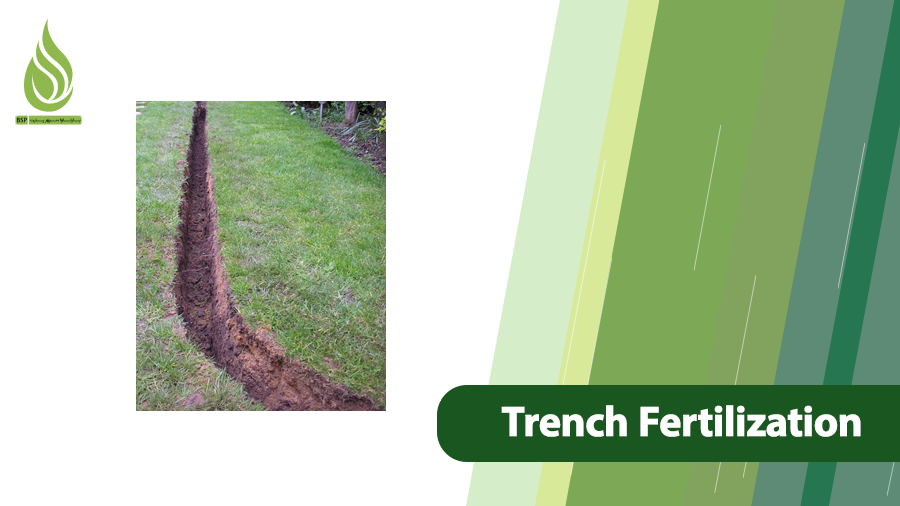
Trench Fertilization & Deep Feeding Orchards
Fruit tree nutrition is one of the most critical aspects of orchard management. Tree root systems are designed so that the majority of nutrient uptake happens in the middle soil layers, where the fine, actively absorbing roots are concentrated. That’s why choosing the right fertilization method has a direct impact on yield, fruit quality, and the tree’s ability to withstand stress. Trench fertilization is an advanced, efficient method for feeding trees. It places nutrients right where the active roots can access them, maximizing uptake and minimizing waste.
In this guide, we’ll walk through exactly how to perform trench fertilization, explore its key benefits, and compare it to the traditional pit method—one of the oldest and most common fertilization techniques. Whether you’re managing a young orchard or revitalizing an established one, understanding trench fertilization will sharpen your nutrient management and boost your results.
What Is Trench Fertilization?
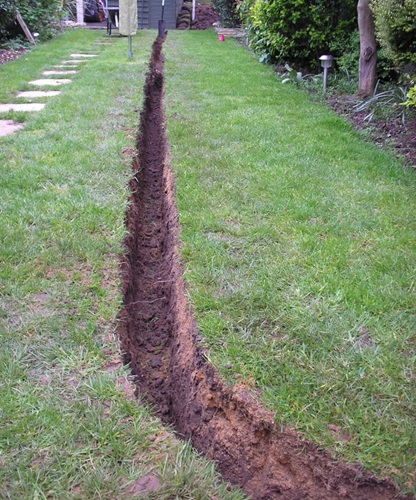
Trench fertilization is a method in which a long, continuous furrow or trench is dug along the tree row. A blend of organic and chemical fertilizers is placed inside this trench and then covered back with soil. The trench is typically positioned in the zone where the highest concentration of fine feeder roots—the roots responsible for nutrient absorption—is located.
This method is especially useful for soils with known nutrient deficiencies or for trees showing strong signs of nutrient stress. Trenches are generally dug to a depth of 12 to 20 inches and a width of about 16 inches. In orchards where tree rows are widely spaced, the trench width can be increased accordingly. The length of the trench matches the linear row of trees. The best time to carry out trench fertilization is from late fall to late winter, when the trees are fully dormant. The work must be done after dormancy sets in but before active growth resumes the following season.
Why Trench Fertilization Matters: Key Benefits
Trench fertilization offers several important advantages that make it highly attractive for large orchards and professional nutrient management programs.

- Uniform nutrient delivery to active roots: The continuous trench creates a long band of nutrients that the tree can draw from quickly and evenly. The high contact surface area and uniform distribution of nutrients in the root zone are major strengths of this method.
- Reduced risk of root burn: Because the fertilizer is spread along a line rather than concentrated in one spot, salt concentration doesn’t spike in any single location, protecting sensitive roots from burn.
- Broad soil structure improvement: Trenches cover a wide area. The organic material in the trench mix improves soil aeration, water infiltration, water retention, and microbial activity across a large portion of the root zone.
- Ideal for high-density orchards: In closely spaced plantings, digging large individual holes is difficult or impossible. Trench fertilization provides a practical solution for these settings.
- Mechanization-friendly: Trench fertilization can be mechanized. Using a cultivator, trencher, or small backhoe, the work can be done quickly and uniformly—a huge advantage for multi-acre orchards.
- Reduced fertilizer loss: Placing fertilizer below the soil surface reduces nitrogen volatilization, limits nutrient leaching, and minimizes the loss of organic matter to erosion or runoff.
- Better growth and fruiting: Orchards fed with trench fertilization tend to show more balanced vegetative growth, better fruit quality, and higher, more consistent yields.
- A long-term feeding zone for roots: By creating a continuous trench, you are essentially building a nutrient reservoir for the tree’s root system. This zone allows deep, ongoing root penetration and expansion over several future seasons.
- Environmental protection: Trench fertilization keeps chemical fertilizers—especially nitrogen and phosphorus—from directly entering groundwater or surface runoff. Lower chemical leaching protects vital water resources and the wider environment.
Step-by-Step Guide to Trench Fertilization
Follow these steps carefully to get the best results from trench fertilization.
Step 1: Pick the Right Time
The optimal window is early to late winter, before the trees wake up. During dormancy, roots are not actively growing, giving the fertilizer time to break down and integrate into the soil before the spring flush.
Step 2: Determine Trench Placement

The trench must be located where the highest density of fine feeder roots is found. A good rule of thumb is to position the trench slightly outside the tree’s drip line—the point on the ground directly below the outer edge of the canopy. Do not dig the trench too close to the trunk, where roots are thick and woody and lack absorption capacity. Likewise, avoid placing the trench too far away, where few feeder roots exist, as the fertilizer would simply go to waste.
In soils that are not severely depleted, a single trench on one side of the tree row is usually sufficient. If the soil is very poor, you can dig trenches on both sides of the row.
Step 3: Dig the Trench
Use a small excavator, trencher, or manual labor to dig. Recommended dimensions:
- Depth: 12 to 20 inches, depending on tree type and root depth. Younger trees need shallower trenches; older trees can benefit from deeper ones.
- Width: Typically 8 to 16 inches.
- Number of trenches: Depends on tree age, size, and the nutritional condition of the soil.
Step 4: Prepare the Fertilizer Blend

A typical trench mix includes:
- Organic fertilizers: well-rotted manure, compost, or vermicompost.
- Mineral fertilizers: phosphorus, potassium, sulfur, nitrogen, and micronutrients (iron, zinc, manganese).
Important points: Make absolutely sure the manure is fully decomposed. For every pound of chemical fertilizer, use 2 to 3 pounds of compost to dilute salt concentration and prevent root burn.
At this stage, selecting the right nitrogen source matters. A fertilizer like ammonium sulfate is a strong candidate because it provides both nitrogen and sulfur, supports the tree’s vegetative growth, and helps acidify the root zone in alkaline soils—a common challenge in many orchards.
Step 5: Fill and Cover the Trench
Spread the fertilizer mixture evenly along the bottom of the trench. Then refill the trench with the excavated soil. Press the soil down lightly to eliminate large air pockets and ensure good soil-to-fertilizer contact, but do not compact it heavily.
Step 6: Irrigate Immediately
Water the trench right after filling. Water helps dissolve the fertilizer and moves it toward the feeder roots. It also settles the soil and removes remaining air pockets.
Trench Fertilization vs. Pit Fertilization: A Detailed Comparison
In orchard nutrition management, two common deep-fertilization methods are frequently debated: trench fertilization and pit fertilization (often called “drill hole” in traditional practice). Many growers assume the two methods are essentially the same, differing only in hole dimensions, but that’s not accurate.
In pit fertilization, deep individual holes are dug around each tree to deliver fertilizer directly. In trench fertilization, nutrients are placed in a continuous furrow of specific depth and length. The table below highlights their key differences.
| Feature | Pit Fertilization | Trench Fertilization |
|---|---|---|
| Hole shape | Deep, separate holes (usually 4 per tree) | Long, continuous trench |
| Soil contact surface | Limited (concentrated in specific spots) | High (more uniform distribution) |
| Root burn risk | Higher (if fertilizer is concentrated in one spot) | Lower (due to dispersion) |
| Best suited for | Widely spaced trees, open orchards, old trees | High-density orchards, row plantings, young orchards |
| Depth of application | Deep (20–32 inches or more) | Moderate (12–20 inches) |
| Ideal fertilizer type | Rotted manure, slow-release fertilizers | Soluble chemical fertilizers, compost |
| Fertilizer use efficiency | Low and localized | Higher but more uniform and effective |
| Mechanization potential | Limited | Fully possible with machinery |
| Cost and labor time | More time-consuming and expensive (requires more labor) | Faster and lower-cost |
| Root impact | Risk of cutting major deep roots | Less cutting of deep roots |
| Soil improvement effect | Localized correction | Broad, lasting soil improvement |
When to Use Trench Fertilization and When to Choose Pit Fertilization
If your goal is targeted, low-cost soil improvement, pit fertilization can be a good choice. But if you manage a larger orchard or want a more advanced, scientific, and uniform nutrient delivery system, trench fertilization is the clear winner.
Consider trench fertilization when:
- Your orchard is densely planted and trees are close together.
- You need to supply chemical fertilizers with precision and uniformity.
- Your soil is light and roots tend to grow shallow.
- Labor and time are limited.
- You have a young orchard that hasn’t yet developed full canopy shading.
Consider pit fertilization when:
- Your orchard has open space and widely spaced trees.
- Your primary goal is to incorporate large volumes of rotted manure or compost.
- You want to encourage roots of old trees to grow deeper, increasing resistance to wind and drought.
- Your soil is heavy clay and requires deep amendment.
- The trees are very old and you need deep, long-term feeding to rejuvenate the orchard.
Putting Trench Fertilization into Practice

Trench fertilization represents a shift from scattered, shallow feeding to a concentrated, root-zone-focused nutrition strategy. When executed correctly, it builds a lasting, fertile zone underground that supports vigorous tree growth and consistent yields for years. By pairing the right mechanical approach with the right fertilizer choices—including high-quality nitrogen and sulfur sources like ammonium sulfate—you create an environment where roots can thrive and nutrient loss to the environment is minimized. Whether you’re starting a new block or upgrading an existing orchard, trench fertilization is a practical, scalable investment in the long-term productivity of your trees.